Andheri Head Post Office Andheri, Mumbai, Maharashtra, India Pin Code: 400053
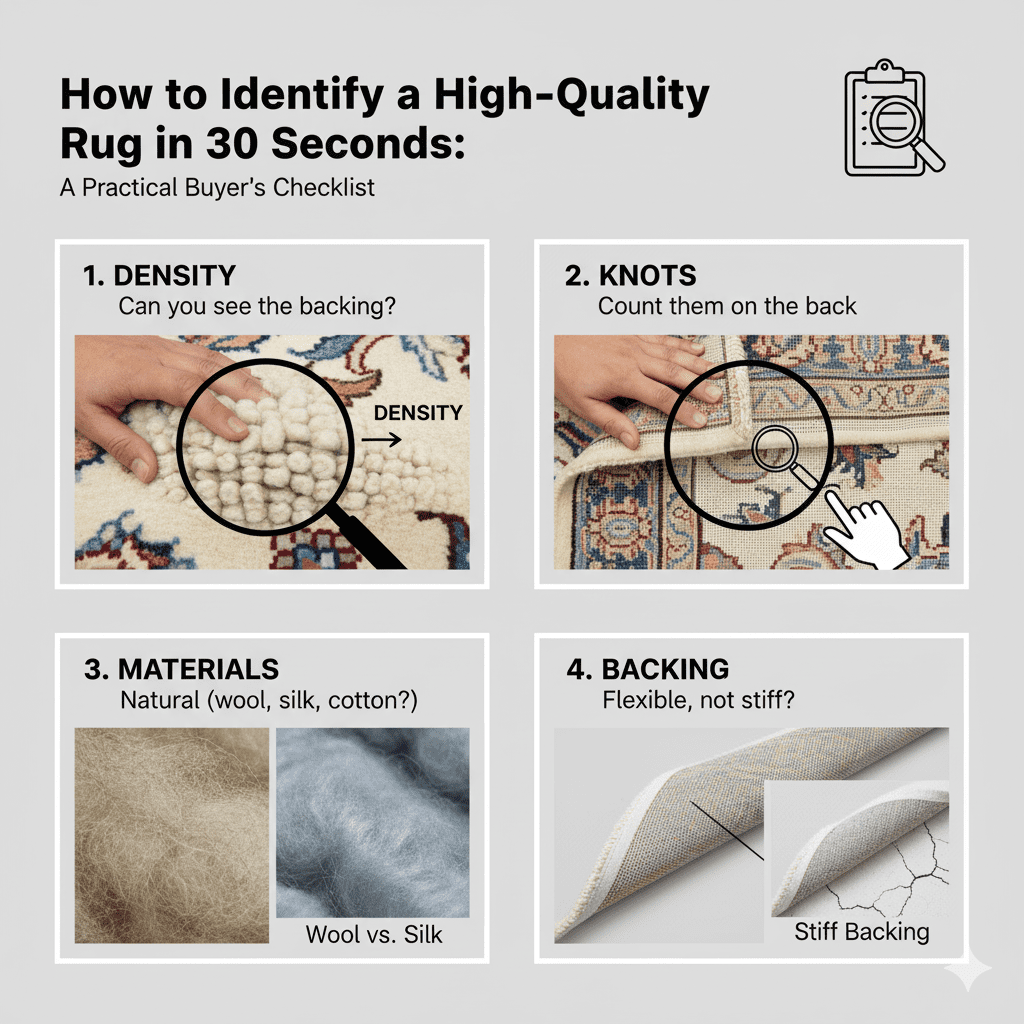
How to Identify a High-Quality Rug in 30 Seconds: A Practical Buyer’s Checklist

Most customers can’t tell the difference between a premium rug and a mediocre one — especially when both look good on Day 1. Retailers know this, and the market is full of rugs that look expensive but fall apart fast.
If you want to avoid overpriced, low-quality pieces, you need a fast, reliable way to judge quality. No jargon. No deep textile knowledge.
Here’s a 30-second checklist that exposes quality instantly.
1. Flip the Rug The Back Never Lies
A good rug’s back tells you more than the front.
What to look for:
- Tight, even knots or stitching
- Consistent pattern visible from the back
- No glue patches or rubber layers
Red flag:
If the back looks messy, uneven, or covered in latex glue — the rug won’t last.
2. Do the Fold Test (Reveals Knots, Density, Lifespan)
Fold the rug slightly.
- If it folds easily and shows large gaps → low density, cheap weave
- If it resists folding and gaps are minimal → high density, long-lasting
Higher density = stronger rug = retains shape for years.
3. Check for Shedding in One Swipe
Run your hand over the surface.
Good rug: almost no loose fibers
Bad rug: visible shedding or fluff
If a rug sheds in the showroom, it’ll shed even more at home.
4. Look at the Edges (The Silent Indicator of Craftsmanship)
Edge finishing decides how long the rug will hold together.
Quality edges have:
- Tight overlocking
- No loose threads
- No fraying
Cheap rugs always fail at the edges first.
5. Material Check: Natural vs Synthetic
You don’t need to be an expert. Just remember:
- Wool: durable, soft, fire-resistant
- Silk: luxurious, delicate, high-end
- Cotton: breathable, lightweight
- Viscose: shiny but fragile
- Polypropylene / Polyester: affordable, stain-resistant, but lower lifespan
Choose based on use, not hype.
6. Weight Test — Heavier Rugs Are Usually Better
Pick up the rug slightly.
Heavier usually means:
- Higher density
- Stronger backing
- Better durability
Lightweight rugs often cut corners.
7. Check Color Consistency
Look at the rug from different angles and lighting.
High-quality rug:
Uniform color, clean transitions, no patchiness.
Low-quality rug:
Uneven shades, dull areas, color bleeding.
8. Smell Test (Most People Ignore This)
A new rug shouldn’t smell like chemicals.
If it does:
- Cheap dye
- Synthetic glue
- Low-grade latex backing
These rugs deteriorate faster and are unsafe for sensitive users.
Bottom Line
A rug can look beautiful and still be low quality.
Using this simple 30-second checklist, you’ll instantly know what’s worth your money.
The backside, density, edges, and shedding tell the true story not the showroom “look.”